
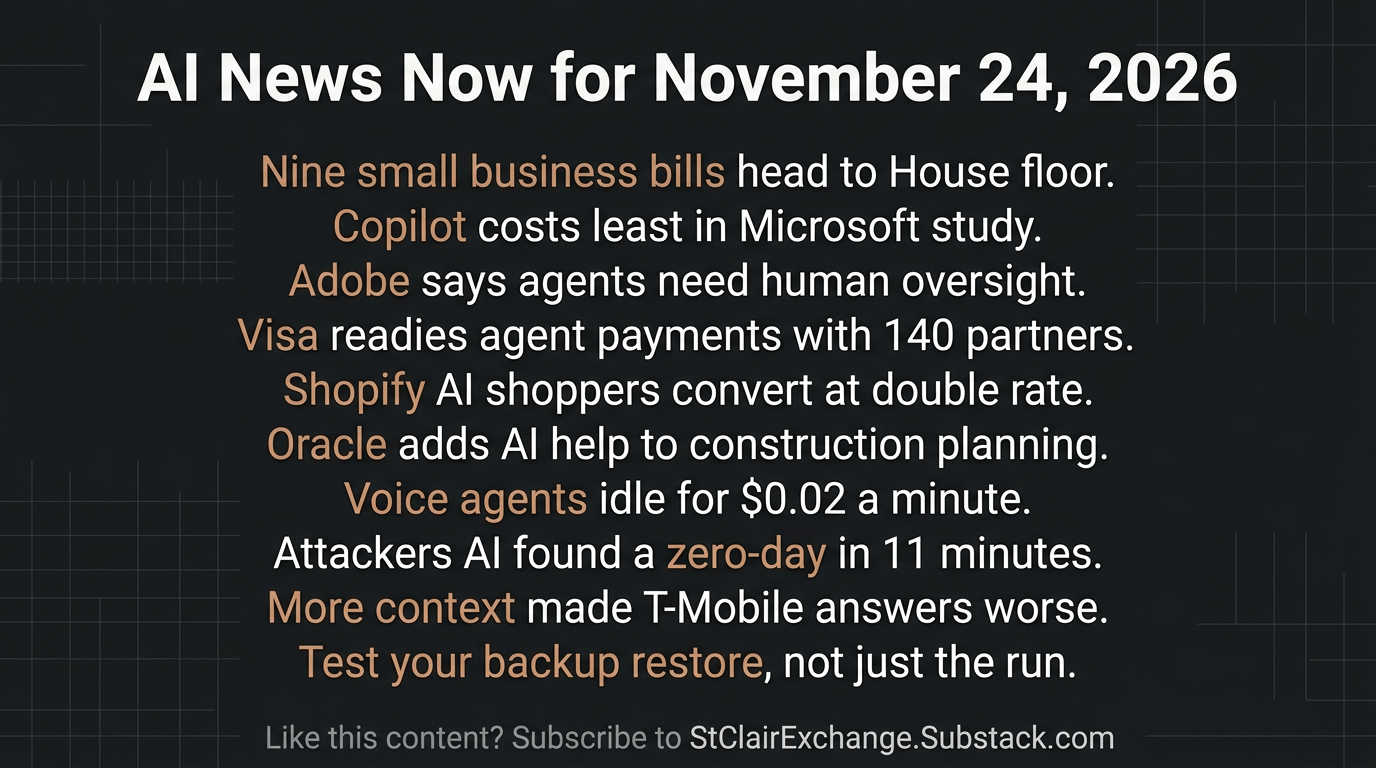
Nine small business bills head to the House floor, AI agent shopping is getting real, and voice agents just got cheaper to run for small shops.
Here’s just some of what is happening in AI News Now…
House Committee Advances Nine Bipartisan Bills to Boost Small Businesses – The House Committee on Small Business sent nine bipartisan bills to the House floor, adding to 39 small business bills already passed this year. The package covers SBA accountability, access to capital, support for American manufacturing, and cybersecurity help for small firms. One bill would require federal agencies to pay small contractors at least 50 percent when project specs change mid-job, a direct help for cash flow on government work.
Study Reveals Microsoft Copilot Offers Lowest AI Costs for Users – Microsoft and GigaOm compared the total cost of running Copilot, ChatGPT Enterprise, and Claude Enterprise for everyday and advanced users. Copilot came in lowest in both groups, at $30 a month for everyday users against $81 for ChatGPT and $205 for Claude, and $96 a month for advanced users against $149 and $299. Output quality was broadly comparable across the three, but remember this is Microsoft’s own research, so test it on your own work before you switch.
Adobe Says AI Agents Need Oversight to Deliver Real Value – Adobe says the key question is not what AI can do, but how much authority it should have. Generative tools are enough for drafting, summarizing, and spotting themes in customer feedback, while agents that act across your CRM, sales, and service systems need tighter permissions, clean data, and human review. Start with one narrow, measurable job, involve the staff who do the work, and only widen the agent’s authority when the time saved is worth the added risk.
Visa Launches Agentic Ready, Uniting 140+ Partners for AI Commerce – Visa expanded its Agentic Ready program to more than 140 partners, including PayPal, Stripe, and Fiserv, to help merchants accept purchases made by AI agents. The program aims to verify who the agent is, what the customer approved, and that the payment moves through existing rails safely. For sellers, the near-term effect is on B2B invoicing and checkout, where agents can already automate payments, so keep your pricing and stock data accurate, since that is what agents read first.
Shopify’s AI-Driven Commerce Expands Access for Brands and Shoppers – Shopify says AI is now a front door into commerce, with AI-driven traffic to stores up 2.6 times. AI searches that run on the Shopify Catalog convert at double the rate of other AI searches, and AI shoppers reach product pages at three times the rate of standard search, with conversion 64 percent higher. Small and niche sellers benefit most, since 75 percent of purchases from AI recommendations come from outside the top 100 product categories.
Oracle Unveils AI-Driven Enhancements to Boost Construction Project Efficiency – Oracle added AI features to Primavera Cloud, its project planning tool for construction and engineering teams, announced November 18. An AI help assistant answers setup questions, a shared risk library carries lessons from past jobs into new ones, and pull planning now lets owners, contractors, and subs work back from milestones to daily tasks. Small builders should note the AI assistant needs an admin to turn it on, so check with whoever runs your system before counting on it.
OpenAI Ships GPT-Live-1.1 for Voice Agents, Cuts Idle Cost to $0.02/Min – OpenAI shipped GPT-Live-1.1 for voice agents in its API, with clearer accents, better transcription, and more reliable task completion. The big cost change is standby mode, which bills idle time on a call at $0.02 a minute instead of $0.05, a 60 percent cut for always-on phone agents that wait between callers. Note that OpenAI published no benchmark scores for the new version, and the backend model that does the reasoning is billed separately.
Amazon says attackers’ AI agents found and exploited a zero-day in 11 minutes, but no patched release is available – Amazon says attackers used AI agents to find and exploit a zero-day flaw in MONAI Label, an open-source medical imaging AI app, in about 11 minutes. The agents used a file-upload flaw to place files outside the app’s storage area and later took full control of the server. The fix was merged into the code on October 19, but no patched release is out yet, so anyone running it should turn on authentication, keep it off untrusted networks, and check for signs it was already hit.
Giving its AI more to read made T-Mobile’s answers worse – T-Mobile tried loading all of its customer support documents into one AI agent, and the answers got worse, because conflicting guidance sent the agent down the wrong path. A knowledge graph was too slow for live calls, so the team switched to a simple lookup table that maps how customers phrase questions to the right process. A VentureBeat survey found 78 percent of companies with agents on company data traced at least one confident but wrong answer to missing or inconsistent context in the past six months, so clean up the source material before you add more of it.
Executive Briefing: Your backup job says it ran. Could your team actually restore what it needs? – Nate’s executive briefing on AI cyber defense argues that backups only count if you can actually restore from them, and it lays out eight quick audits covering accounts, connected apps, exposed systems, data, backups, detection, AI agents, and shared dependencies. AI now lets attackers investigate a system, adapt when blocked, and keep going, while suppliers can reach further into your business than most owners realize. Run the restore test this week, not after an incident, and check what each supplier and agent can touch.
Important! For more stories like this, check out our ‘Notes’ section!
Enjoy the day!
Matthew Doehring
Repost or Share this article to help others and follow for more AI News, Fun Facts, Helpful Hacks and more.
Originally published on St. Clair Exchange: https://stclairexchange.substack.com/p/ai-news-now-for-november-24-2026


