Factories are adding AI that acts, not just advises, while owners still ask what it costs and what it returns. Oversight, spending checks, and simpler analytics lead this week.
Here’s just some of what is happening in AI News Now…
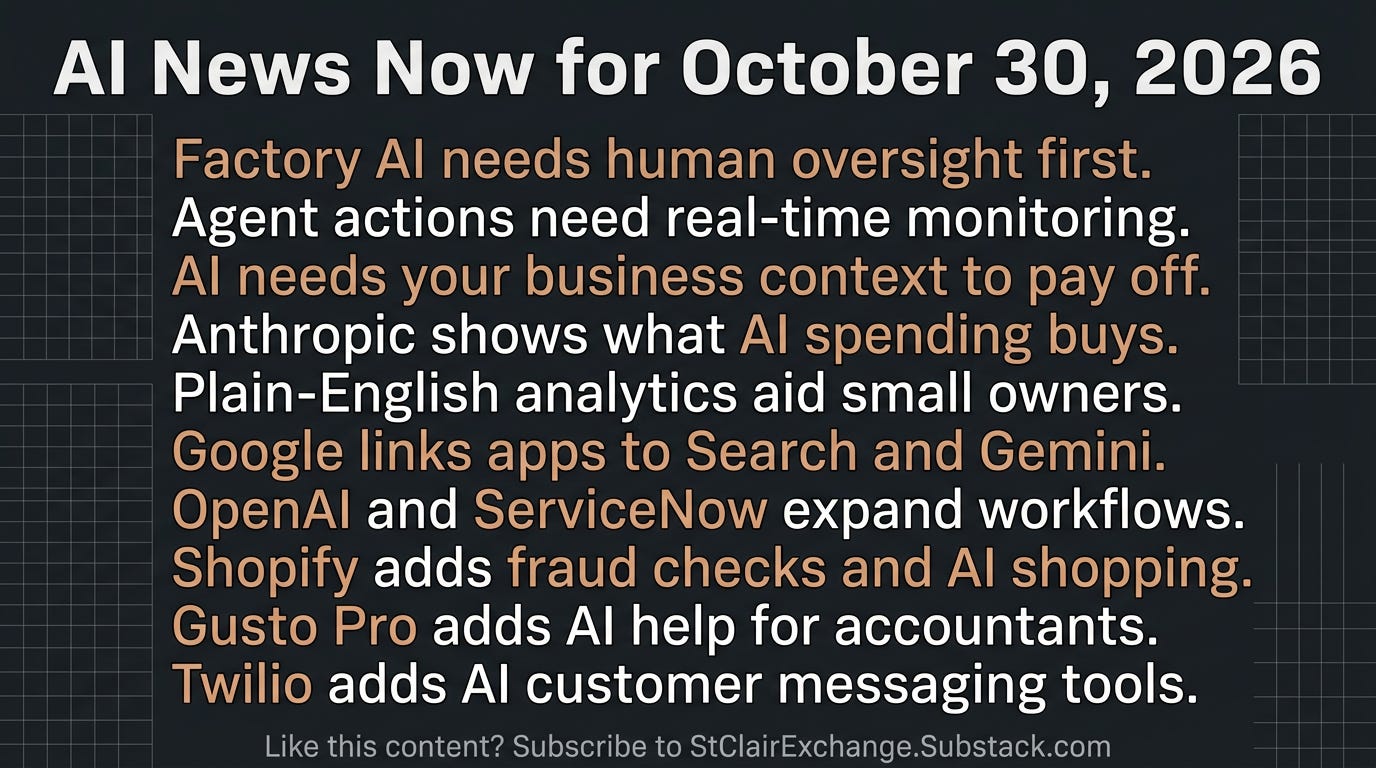
Pairing industrial AI autonomy and human control – A 2026 survey cited by MIT Technology Review found 66% of manufacturers are using or plan to use agentic AI, while 40% expect some factory autonomy by 2030, yet 65% of executives ranked operational risk among their top concerns. The practical model is supervisory: AI handles narrow, repetitive adjustments, and people set the limits and check the work. Start with one process, define what AI may do alone, and keep a human approving anything that affects safety, quality, or a customer order.
We urgently need to monitor AI agents’ actions in real time – Researchers found that widely used agent frameworks often lack persistent agent IDs and clear records of who approved a task, which makes it hard to tell which agent did what. That matters once an agent can touch orders, files, or customer data, because a problem found later is hard to trace back. Before you scale any agent, require a log of its actions and approvals, limit its permissions to one job, and review its runs on a schedule.
How to increase your energy levels (without drugs or caffeine)
Creating AI value with enterprise context – In an MIT Technology Review Insights poll, only 16% of organizations said they get transformative value from AI, while 40% reported moderate gains on specific tasks and 38% are still piloting use cases. The missing piece identified in the report is business context: AI that cannot draw on your own systems and records will give generic answers. Connect one clean source first, such as sales or job records, and judge the tool by whether its answers match numbers you already trust.
Anthropic just launched tools to show companies what their AI spending is buying – Anthropic added reporting that shows what a team produced, what it cost, where workflows broke down, and how results could improve, plus pooled budgets to control token spending. The timing fits a wider warning: one survey cited in the report found spending on agentic coding tools up 10 times since the start of the year. Ask any AI vendor for the same breakdown, output, cost, and failures, before you renew or expand.
Plain-English Analytics Gives Small Businesses Answers Without an Analyst on Payroll – New analytics assistants let owners ask questions in plain language, such as what sold last week or which regulars have not visited in 90 days, and get a number or chart back. Census data cited in the piece found fewer than 20% of firms with four or fewer employees reported using AI, while a Chamber survey found AI users at least 7 points more likely to report sales, profit, and workforce growth. Pick the one number you check every Monday, connect only the records behind it, and check each new answer against a number you already know.
Google Launches Connected Apps Platform to Simplify Daily Tasks – Google’s Connected Apps Platform lets developers build an app once and surface it in both Search and the Gemini app, with verified logos and real-time traffic data. For a small business, the point is discovery: customers already searching for a service could reach your app without hunting for it. The rollout is phased, so treat this as a question for your developer or platform provider, not a rebuild, and watch whether it brings real bookings.
OpenAI and ServiceNow expand partnership across enterprise workflows – ServiceNow is bringing business context and workflow actions into ChatGPT, so an IT staffer can find similar incidents, assess the risk of a change, and update a record without leaving the chat. Actions still follow the company’s existing ServiceNow rules and permissions, which is the part worth copying. Even if you do not use ServiceNow, keep AI inside your current permissions, and do not give it a side door around approvals your team already uses.
Shopify’s Fall ’26 Update Enhances Merchant Capabilities with AI and Security – Shopify’s Fall ‘26 release adds Shopify Protect fraud rules and dispute tools at no added cost, expanded local payment options, in-store recognition of returning shoppers, and a Shop Promise mark for eligible U.S. products with delivery and return guarantees. A new shop.md feature also lets an AI agent shop across Shopify stores with Shop Pay checkout. If you sell online, check the fraud rules and Shop Promise eligibility first, since fewer chargebacks and clearer delivery terms help a small store more than a new AI feature alone.
Gusto Empowers Accounting Firms with AI-Driven Guidance Solutions – Gusto Pro gives accounting firms AI-driven analytics, real-time client insights, and automated compliance and payroll work, with the aim of freeing accountants for advisory work instead of admin. For owners, the value shows up as clearer cash flow help and faster reporting, not as software for its own sake. Ask your accountant what new monthly insight you will actually receive, and what it costs, before you switch systems or pay for an upgrade.
Twilio Unveils Powerful AI-Driven Tools for Enhanced Customer Engagement – Twilio combined messaging, voice, email, and AI coordination so small businesses can send order updates, answer routine questions, and tailor promotions across channels. A bakery sending automated order updates by text is a good example of a narrow, useful start. Keep it to one channel and one job first, watch the cost as volume grows, and make sure customer data handling stays within the rules you already follow.
Enjoy the day!
Matthew Doehring
Repost or Share this article to help others and follow for more AI News, Fun Facts, Helpful Hacks and more.
Originally published on St. Clair Exchange: AI News Now for October 30, 2026