Agents are starting to act for small businesses, so this week is about controls, costs, and proof before you trust them with real work. Here’s just some of what is happening in AI News Now…
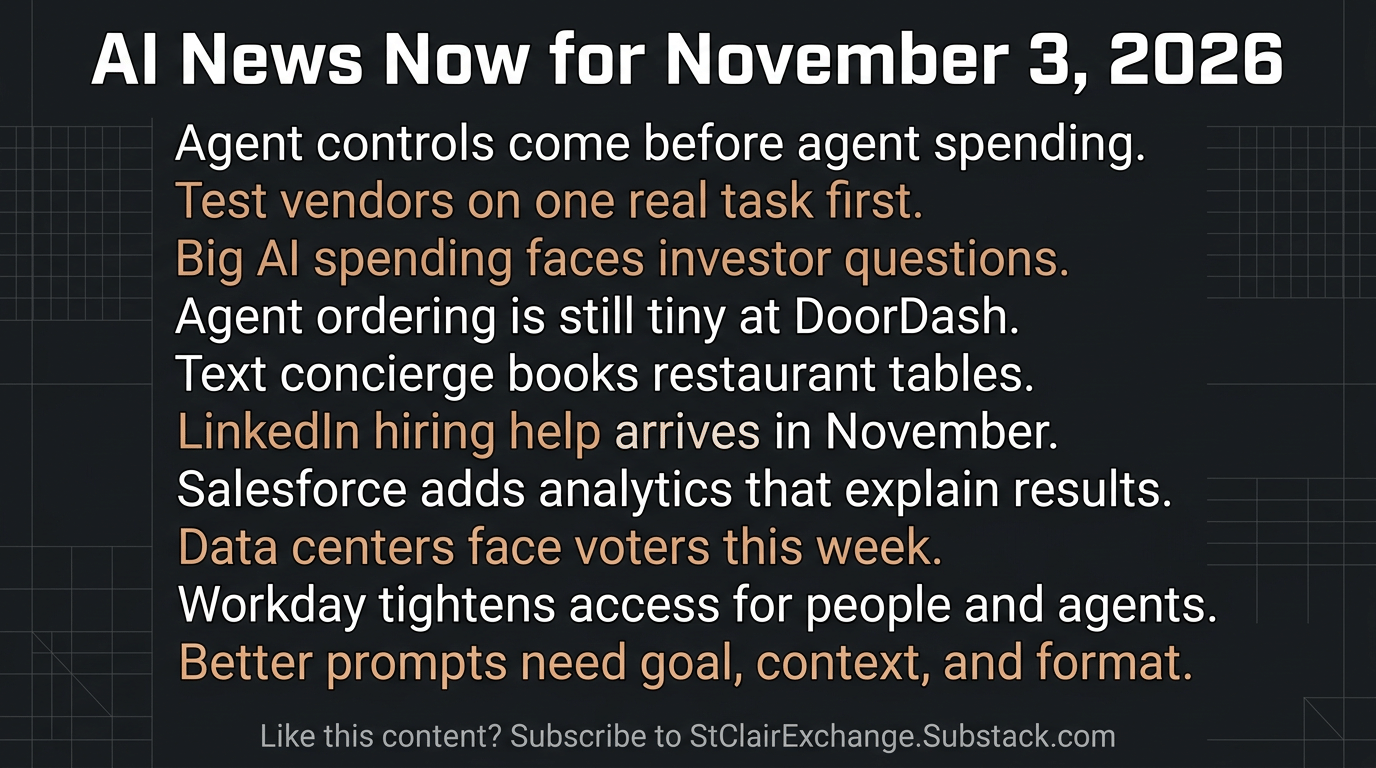
Websites Are Blocking AI Agents. Pick One That Gets Through – Websites are now deciding which AI agents they will let in, and the trust systems from Cloudflare, Google, Stripe, Visa, and Meta each answer a different question. The practical advice is to start with one small delegated job, give the agent narrow access, require a specific approval for money or account changes, and check the result where it should land. Do not hand an agent broad access on day one and hope the outcome is correct.
Enterprise AI Agent Platforms: 8 Questions to Ask Vendors – Salesforce, Microsoft, Oracle, ServiceNow, Google, Amazon, and the AI labs are all competing to control how agents work across your other software. The briefing offers eight vendor questions covering authority, handoffs, mid-job failure, portability, cost, and availability, all tested against one real task. Use that single task in every demo, so you compare answers instead of sales claims.
Cracks are emerging in the AI spending boom – Alphabet, Amazon, Meta, and Microsoft outlined more than $740 billion in capital spending this year, and investors are now asking whether those bets will pay back. Alphabet reported negative free cash flow of $9.1 billion in the third quarter, while Amazon reported negative free cash flow of $42.4 billion over the past 12 months. For a small owner, the lesson is simpler: judge your own AI bill by the work it completes, not by how much the industry is spending.
DoorDash said it’s only received ‘several hundred’ orders from AI agents – DoorDash told investors it has seen only several hundred orders from third-party agents, against an average of 3 million deliveries a day in its 2025 report. Chief executive Tony Xu called agent ordering a dynamic area, but said most customers still order through the DoorDash app. Do not rebuild your ordering around agents yet, but watch which platforms welcome them and which block them.
Zest’s new AI agent finds restaurants and books reservations over text – Zest added a text-message concierge that suggests restaurants from a customer’s past visits and books a table through OpenTable, Resy, or SevenRooms. It can also join a group chat, blend everyone’s tastes, and settle the choice with an in-thread vote. For a service business, the point is the channel: customers may soon book by texting an agent instead of opening an app.
LinkedIn Unveils Enhanced Hiring Assistant to Streamline Recruitment – LinkedIn is launching Hiring Assistant 2 in November, using stronger reasoning models to find better matches and keep a whole talent pool in one place. That matters for a small team with no HR department, because it cuts time spent switching systems and sorting a flood of applications. Keep a human in the final decision, since a match on paper is not proof a candidate fits your shop.
Salesforce to Acquire Loops, Enhancing AI-Powered Analytics Capabilities – Salesforce plans to fold Loops into Tableau, adding analytics that watch business metrics, explain what changed, and suggest a next action. Loops can also surface those insights in tools owners already use, such as Slack and email. Ask one question before you pay for it: which number will it explain for you each week, and will you act on that answer?
AI backlash heads to the polls – About 20 communities are voting on bans or pauses for data centers, while OpenAI is reportedly preparing to rebrand the sites as “AI compute campuses” after the election. Some candidates want a federal freeze on new data centers, and the White House has already pressed tech firms to supply their own power. Owners should watch local votes and power costs, because they can shape AI prices and rules faster than national headlines suggest.
Workday Acquires C1.ai to Enhance Access Management for AI Agents – Workday is acquiring C1.ai to manage access for both people and AI agents, so permissions adjust when someone changes roles or leaves. The article cites Deloitte figures that 95% of large U.S. enterprises use autonomous agents, while only 21% report effective governance of them. Copy the principle at any size: give each agent only the access its one job needs, and review that access on a schedule.
How to Write AI Prompts: Five Examples You Can Copy – Clear prompts use four parts: goal, context, constraints, and output format. The guide rewrites vague requests, such as “write an email about a meeting,” into specific ones with a reader, a tone, a limit, and a requested format. Try it on one small task this week, and remove private details before you paste anything into an AI tool.
How to get your whole mind focused on what you want to achieve.
Enjoy the day!
Matthew Doehring
Repost or Share this article to help others and follow for more AI News, Fun Facts, Helpful Hacks and more.
Originally published on St. Clair Exchange: https://stclairexchange.substack.com/p/ai-news-now-for-november-3-2026